In the landscape of pharmaceutical manufacturing and medical devices, sterility assurance is not merely a regulatory requirement, but the fundamental pillar of patient safety. When a product is labeled as sterile, the theoretical probability of a microorganism surviving the sterilization process must be less than one in a million (SAL ≤ 10-6).
However, the mere validation of the sterilization process (thermal, radiation, or ethylene oxide) is not sufficient. Sterility testing stands out as the ultimate batch-release quality control, a delicate and complex analytical investigation requiring rigorous environmental standards and validated methodologies in accordance with international pharmacopeias (Ph. Eur., USP and JP pharmacopeias).
Control on Drug Products: Membrane Filtration and the Steritest System
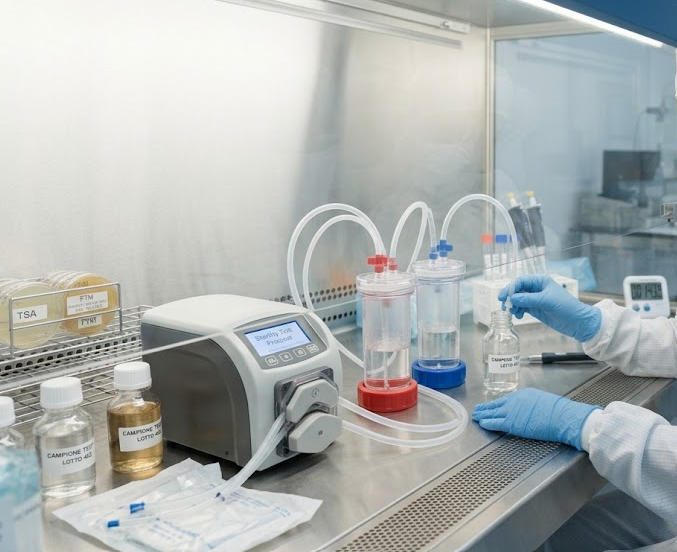
For most liquid pharmaceutical products, biologics, and injectable drugs (Drug Products), the preferred method recommended by regulatory authorities is membrane filtration, commonly performed using closed systems such as the Steritest equipment.
Operating Principles of the Steritest Method
The closed Steritest system utilizes single-use filter units equipped with microporous membranes (typically with a nominal pore size of 0.45 μm). This approach completely isolates the sample from the external environment during all handling phases:
- Sample Transfer: The liquid is transferred by gravity or via a peristaltic pump into the filtration canisters, trapping any microbial load present onto the membrane.
- Rinsing Phase: Specific washing fluids (e.g., Fluid A or Fluid K) are applied to remove residues of active ingredients, preservatives, or bacteriostatic excipients that could invalidate the assay by inhibiting microbial growth.
- Inoculation of Culture Media: Sterile culture media are introduced directly into the canisters within the same closed circuit:
- FTM (Fluid Thioglycollate Medium): Optimal for the growth of anaerobic and aerobic bacteria, incubated at 30–35 °C.
- TSB (Tryptic Soy Broth): Ideal for fungi, yeasts, and aerobic bacteria, incubated at 20–25 °C.
Incubation generally lasts for a period of no less than 14 days, during which the containers are visually monitored to detect any onset of turbidity, which indicates contamination.
Control on Medical Devices: The Direct Inoculation Technique
Unlike liquid drugs, medical devices exhibit an extreme variety of morphologies and structures (catheters, orthopedic prostheses, heart valves, pre-filled syringes, surgical kits). For this category of products, membrane filtration is often inapplicable, making the use of the direct inoculation method necessary.
Execution and Analytical Challenges
In the direct inoculation method, the entire medical device or representative sections of it are immersed directly into containers holding culture media (FTM and TSB).
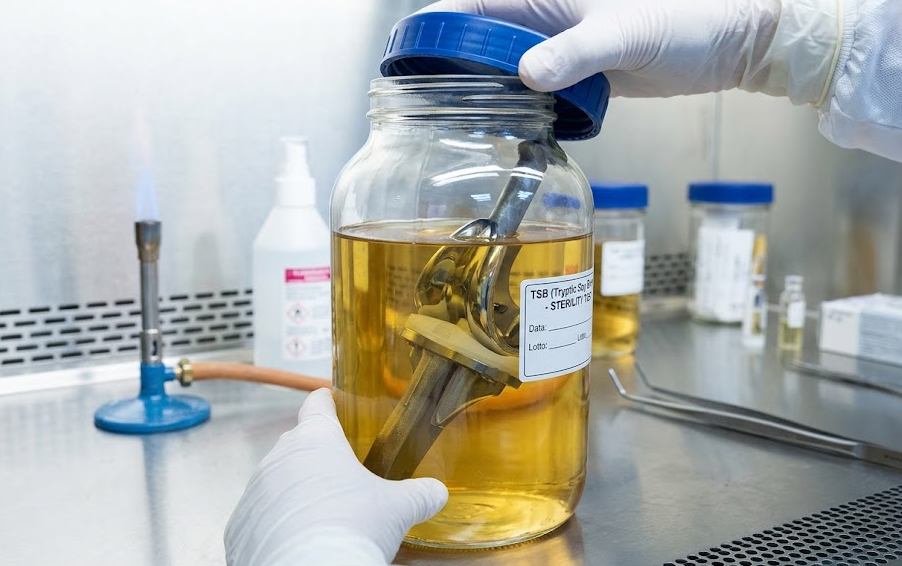
- Sample Preparation: Devices must be handled inside strictly validated isolators or laminar flow hoods (Class A in a background of Class B). Where possible, hollow components or lumens are internally filled with culture media to ensure direct contact with critical surfaces touching the patient's tissues.
- Neutralization of Inhibitors: Many polymeric materials or medical coatings (e.g., eluted antibiotics or antimicrobial agents) can release inhibitory substances. It is essential to validate the preliminary method suitability phase to demonstrate that the culture media effectively support the growth of reference standard strains (e.g., Staphylococcus aureus, Pseudomonas paraeruginosa, Bacillus spizizenii, Candida albicans) even in the presence of the device.
In this case as well, incubation extends for 14 days, periodically verifying the absence of turbidity or abnormal precipitates.
Critical Issues and Analytical Reliability in the Microbiological Laboratory
Performing sterility testing inherently encompasses a series of technical challenges that require rigorous control of process variables:
- The Risk of False Positives: Accidental contamination occurring during cleanroom handling phases can lead to the unjustified rejection of a compliant batch. The use of closed systems (Steritest) drastically reduces this risk compared to traditional open methods.
- The Risk of False Negatives: Caused by incomplete removal of antimicrobial substances or inadequate mixing of the sample within the culture media.
- Testing Environment: Compliance of airflow, continuous microbiological particulate monitoring, and rigorous qualification of operators represent the pillars for ensuring the integrity of analytical data.
Conclusions
The choice between the Steritest filtration method (crucial for liquid Drug Products) and the direct inoculation method (essential for the geometric complexity of Medical Devices) defines the robustness of pharmaceutical quality control. Understanding the fundamentals of these techniques and adhering to pharmacopeial requirements safeguards the production chain and, above all, the clinical health of the final patient.